A research result becomes easier to judge when its supporting information stays beside it. A number needs a description of what was counted or measured. A comparison needs an account of who contributed observations. A conclusion needs enough information about uncertainty to distinguish a useful estimate from an unresolved question. These are practical requirements for reading tretinoin research, especially when a concise abstract is the available account of a larger investigation.
The Skin Ledger approaches this evidence by tracking the meaning of each entry rather than awarding a single score to an entire paper. The review methodology explains the publication's broader approach; this article works through specific statistical problems. Its invented examples are explicitly marked as teaching examples. They illustrate how calculations change when assumptions change, without supplying missing data for any of the actual studies.
48-week tretinoin trial: epidermal thickness change
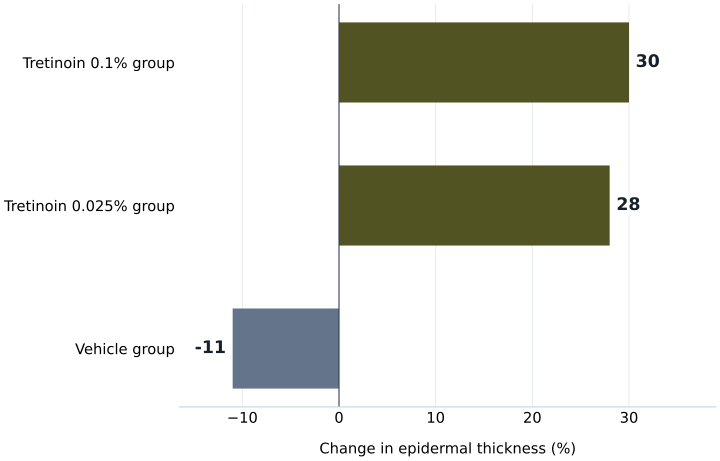
Histologic endpoint; values show percentage change from baseline.
Abstract-only evidence; these are not wrinkle-response percentages.
Download the source-labeled chart (PNG) · Download the data (CSV) · Download the chart (SVG)
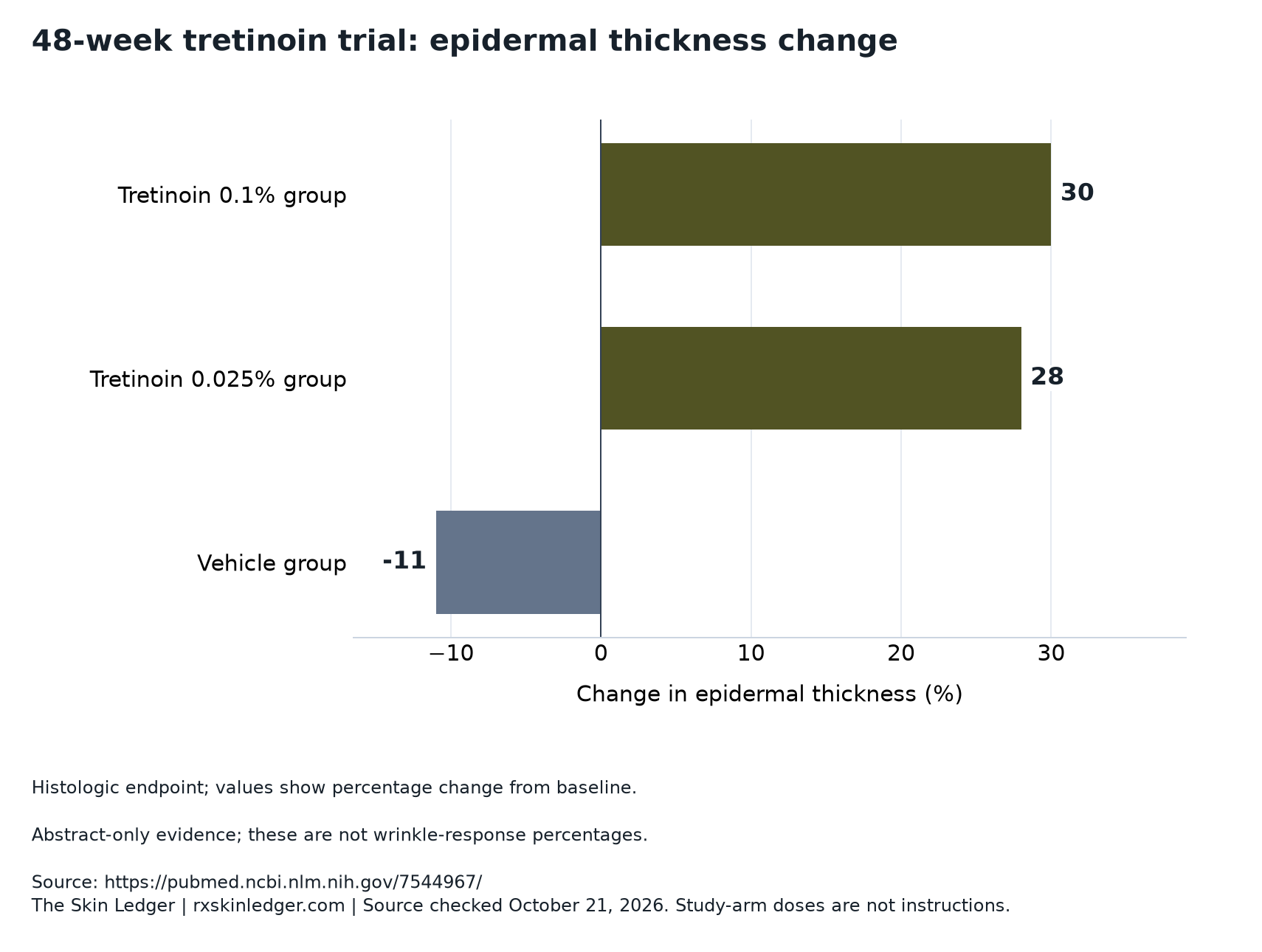
| Study group | Reported value |
|---|---|
| Tretinoin 0.1% group | 30 |
| Tretinoin 0.025% group | 28 |
| Vehicle group | -11 |
Sections in this article
Open the record with the analysis population
The 1995 indexed abstract describes a double-blind, 48-week study of facial photoaging with 99 completers: 32 using 0.1% tretinoin cream, 35 using 0.025%, and 32 using vehicle. Its initial enrollment, allocation procedure and attrition are unreported. The concentrations identify experimental preparations, not an individualized treatment choice.
An evidence ledger should give population counts and allocation methods separate fields. Blinding concerns knowledge of treatment identity; randomization concerns how treatments are assigned. They solve different design problems and should occupy different fields in an evidence record.
The distinction is useful even before calculating anything. Ask which people a result describes: everyone enrolled, everyone treated, those assessed at a particular visit or those meeting an analysis rule. Those sets may coincide, but that must be established rather than assumed. If a report supplies only one set, preserve its stated meaning. The aim is to describe the evidence available, not to infer either a flawless follow-up history or a problematic one from a missing description. Both inferences would exceed the record.
Calculate what an unknown outcome leaves open
Consider an entirely hypothetical study that starts with 20 people, observes 16 at its designated endpoint and records improvement in eight of those observed. Among assessed participants, eight divided by 16 gives 50%. Across everyone who started, eight divided by 20 gives 40% known to have improved. These are different descriptions of the same invented observations, not competing answers to one precisely defined question.
If the four unobserved people all failed to improve, the full-group proportion would be 40%. If all improved, it would be 60%. That range is a simple arithmetic bound based on two extreme assumptions. It is not a confidence interval, does not express sampling uncertainty and does not establish which assumption is plausible. More informative analysis would require reasons for missingness and relevant observed information.
The example explains why an endpoint count cannot reveal a dropout rate without a starting denominator. It also shows why silently treating an unknown outcome as failure makes an additional analytical choice. No such figures are being reconstructed for the concentration study. When checking a claim against the source register, the question is whether its numerator and denominator belong to the same defined population and observation period.
| Calculation | Result in this invented example | Question answered |
|---|---|---|
| 8 improved ÷ 16 assessed | 50% of assessed participants | What proportion of observed participants improved? |
| 8 known improvements ÷ 20 starters | 40% of starters | What proportion of the starting group is known to have improved? |
| 8 to 12 improvements ÷ 20 starters | 40% to 60% of starters | What are the extreme bounds if every unknown outcome is failure or success? |
Identify when an endpoint contains earlier observations
The retinol paper studied 36 adults averaging 87, assigning 0.4% lotion and vehicle randomly to paired sun-protected upper inner arms. Twenty-three completed 24 weeks; the full-group analysis carried forward last observations. Mean changes in the primary fine-wrinkling score, on a 0–9 scale, were −1.64 (95% CI, −2.06 to −1.22) and −0.08 (95% CI, −0.17 to 0.01), respectively; P<.001.
Last observation carried forward means that an earlier measurement stands in for a later missing one. A participant can therefore be included in an endpoint analysis without supplying a measurement taken at that endpoint. Maintaining an analysis count is different from maintaining complete observation. The companion retinol article examines the clinical and laboratory evidence for that distinct ingredient and setting.
Whether carrying forward is favorable or unfavorable depends on the unobserved trajectory. If improvement would have continued, an earlier score could understate it. If deterioration would have followed, that score could overstate the outcome. Neither possibility is a finding about these participants; they explain why the assumption needs scrutiny. A sensitivity analysis asks how conclusions change under alternative plausible assumptions. Simply retaining every participant in a calculation does not, on its own, resolve the uncertainty created by missing follow-up.
Distinguish a measurement denominator from a person count
The concentration report includes epidermal thickness and vascularity measured through dermal endothelial-cell area. These are tissue measurements. A percentage change in a tissue variable uses the starting measurement as its denominator; it does not use the number of participants. Reading that percentage as the fraction of people with fewer wrinkles would substitute an entirely different outcome.
Another illustrative calculation makes the distinction concrete. Suppose a binary response occurs in 25% of one hypothetical group and 40% of another. The difference is 15 percentage points. The relative increase is 15 divided by 25, or 60%. Neither number is a percentage change in wrinkle depth, a clinician's rating or a microscopic feature. They describe proportions of people meeting a defined response criterion in this invented example.
A rating scale introduces another unit: score points. Its categories may organize severity without establishing that one category represents twice the biological quantity of another. Dividing a score change by a baseline score can produce a number mathematically, yet still require justification as a meaningful relative effect. The fine-lines reference names the concern; a scientific claim must additionally identify the measurement used to represent it and the comparison that gives the measurement context.
Ask how precisely the active treatments were compared
Both active concentrations improved facial photoaging relative to vehicle; the abstract reports no clinically or statistically significant efficacy difference between them, without a confidence interval for that contrast. This supports describing the reported comparison. It does not provide a numerical boundary showing how large an undetected difference might be.
Imagine that an equivalence investigation prospectively defines differences between minus 0.4 and plus 0.4 points as acceptably small on a hypothetical scale. An appropriate interval from minus 0.2 to plus 0.6 would extend beyond that margin. An interval from minus 0.1 to plus 0.1 would fit within it. These invented intervals illustrate the role of a justified margin and the specified statistical procedure; they are not estimates for the tretinoin study.
A threshold for statistical significance alone does not supply this framework. Nor can separate uncertainty intervals for two group means automatically substitute for the interval around their contrast. In paired observations, the relationship between measurements affects the calculation. In other designs, different assumptions apply. The evidence ledger should therefore distinguish an available group estimate from an unavailable comparison estimate, even when both would be useful for interpreting the same clinical question. Precision belongs to a defined quantity, not to a paper in general.
Count tolerability outcomes without double-counting people
The higher tretinoin concentration produced more erythema and scaling. These findings concern redness and visible shedding, not a numerical measure of treatment benefit. Tracking tolerability separately prevents a favorable clinical result from erasing discomfort and prevents a reaction from being treated as proof that the desired clinical process is occurring.
For a hypothetical safety example, consider 20 assessed people during eight weeks: six report dryness, five report peeling, and three report both. Adding the symptom-category counts gives 11, but the number with either symptom is eight: six plus five minus the overlap of three. Thus 40% experienced at least one of these two symptoms in the invented example. The count of repeated episodes would require still more information.
A treatment interruption is another distinct outcome. Someone may stop applying a preparation yet remain available for follow-up; someone else may leave follow-up for an unrelated reason. Those events should not share a label by default. Severity, timing, duration and collection method also matter when comparing harms. Finally, parallel changes in irritation and efficacy do not establish that one causes the other. Establishing mediation would require evidence about the proposed intermediate process, its timing and competing explanations, not merely the presence of both outcomes in a study.
Keep the longer trial's endpoints in their own record
A separate randomized trial treated 204 people with moderate to severe facial photodamage using 0.05% tretinoin emollient cream or vehicle for up to two years. Its abstract reports greater clinical improvement (P<.05) but omits effect sizes and confidence intervals. A procollagen marker increased at month 12; histology found no increase in keratinocytic or melanocytic atypia relative to vehicle.
Longer follow-up adds a time dimension, but a longer calendar does not itself make all outcomes comparable. An early response, a later response and maintenance after stopping treatment are different questions. A study can address one while leaving another unanswered. The mature-skin reference can organize related concerns, while an evidence comparison still needs each outcome's definition, collection schedule and analysis population.
Biological measurements also require a separate interpretation from clinical events. A marker of a process can help investigate that process without quantifying a person's future experience. Similarly, a comparison of particular microscopic abnormalities cannot be expanded into protection against every adverse outcome. A convincing synthesis would specify which findings align across studies and which differ in formulation, endpoint or duration. Counting positive findings without those distinctions would give equal weight to quantities that answer different questions and might arise from overlapping biological observations.
Make the formulation part of the claim's address
RENOVA's current labeling applies to 0.02% tretinoin cream for mitigation of fine facial wrinkles alongside comprehensive skin care and sunlight avoidance. It does not claim wrinkle elimination or repair of photodamage. Irritation, increased sunburn susceptibility and restrictions on use during pregnancy or attempted pregnancy are relevant boundaries. About 4% discontinued the drug because of adverse reactions.
A documented product concentration is only one part of matching a research claim to a preparation. The formulation, site, population and accompanying care also define the claim's scope. A finding from one cream does not become a finding for another simply because both contain tretinoin. The RENOVA product review is a place to examine its documentary record; the label remains the appropriate record for its specific indication and warnings.
This distinction also clarifies apparent conflicts. A paper can investigate a broader collection of outcomes than a product's labeled indication. A favorable result in that investigation does not revise the label of a different formulation. Conversely, a narrow indication does not determine every scientific question that researchers may study. In an evidence ledger, the research result and the labeled claim should each retain their own preparation and outcome, rather than borrowing the most expansive wording available from a neighboring record.
Record exactly which evidence was accessible
The access record below distinguishes indexed abstracts from the full retinol paper and current official labeling. That distinction changes which questions can be investigated directly. A concise abstract can establish a reported finding while leaving the details needed to reproduce or critically examine its analysis unavailable. Full-text access opens more of those details to inspection without guaranteeing that every desired analysis was published.
When a method is unreported in the material examined, that is an access-limited observation about the record. It is not proof that investigators failed to use the method. The reverse also matters: a familiar method should not be assumed merely because it would be conventional. Each uncertainty should identify what information would resolve it, such as an analysis definition, participant flow or uncertainty estimate.
Source access and source quality are related but separate judgments. A short record may describe a carefully conducted experiment; a lengthy paper can still leave important questions unresolved. Transparent access notes allow readers to assess how far an interpretation reaches beyond directly inspectable material. They also prevent a later discovery in a full paper from being presented as if it had already been established by an earlier abstract-only reading.
| Record | Material examined | Boundary to preserve |
|---|---|---|
| 1995 concentration comparison | Indexed research abstract | Do not imply review of the full methods or individual data. |
| 2007 retinol experiment | Full publisher article, original table footnote and figures' captions | Clinical-table confidence intervals and completer-figure standard errors are different summaries. |
| 2005 longer tretinoin trial | Indexed research abstract | Do not reconstruct missing effect sizes from significance statements. |
| RENOVA | Full current official labeling | Keep product-specific language attached to its formulation. |
Separate disclosed interests from inferred sponsorship
The retinol disclosure names four investigators as inventors on a patent application, with royalties conditional on licensing and product sales. It does not establish payment. No separate funding statement was located; the two tretinoin abstracts do not identify funding. These are different disclosure states, not interchangeable evidence that a sponsor was present or absent.
An interest statement can identify a possible influence worth considering, but it cannot be converted into a numerical adjustment to an effect estimate. Evaluation still requires the study's methods and reporting. An institutional affiliation, a named manufacturer or a preparation ingredient likewise does not document who funded an experiment. Recording the exact relationship avoids both overlooking a disclosed interest and inventing an undisclosed commercial arrangement.
My editorial interpretation is that this separation should continue when reading service records. The Nurx review and Strut Health review can be consulted for documentary terms, independently of the scientific comparisons here. These links do not establish availability of a studied formulation or equivalent outcomes. A complete comparison keeps research evidence, product labeling and service documentation traceable to their respective sources. A gap in one category cannot be filled merely by locating confident wording in another.
Questions about the evidence
Is an unreported starting count evidence of substantial attrition?
No. Missing information does not establish how many people left or whether anyone left. It limits the calculations a reader can perform. The appropriate entry is that the starting denominator or participant flow is unavailable in the material examined, rather than assigning a favorable or unfavorable history to the study.
Why retain the comparison group when reporting improvement?
A change within a treated group and a difference relative to a comparator answer different questions. The former describes a trajectory; the latter helps evaluate what separates the groups under the design's assumptions. Reporting only the treated trajectory can obscure changes that would also have occurred under the comparison condition.
Can a confidence interval describe every participant's response?
An interval around a group estimate concerns the precision of that estimate under a statistical model. It is not a range containing all individual responses. Understanding variability between people requires information about individual outcomes or their distribution, which is a different quantity from uncertainty around a mean or treatment contrast.
Does stopping a study cream mean someone left the study?
Not necessarily. Treatment exposure and follow-up participation are separate records. A person might stop treatment while continuing assessments, or miss assessments while their treatment history remains uncertain. The report must specify what its discontinuation category means before that count can be interpreted as treatment withdrawal, study withdrawal or loss to follow-up.
What would make a stronger concentration claim more convincing?
A clearly defined target outcome, a direct comparison, an appropriate analysis population and an estimate with relevant uncertainty would help specify the claim. Tolerability would still need separate evaluation. The key improvement is greater specificity about the question and evidence, rather than assuming that a larger printed concentration answers every clinical question.
Editorial assessment
The useful conclusion is an accountable one: preserve the participants represented, the endpoint's units, the comparator and the uncertainty actually reported. Keep missing observations distinct from observed failures and microscopic findings distinct from clinical event rates. This approach allows a result to contribute evidence without promoting it into equivalence, a universal safety judgment or a claim for another formulation. An evidence ledger is most informative when its unresolved entries remain visible and precise enough to guide the next question.
Research access and limitations
This article interprets accessible research records and labeling rather than participant-level data. Source-specific access is recorded in the table; protocols, supplements and individual records were not reviewed. Hypothetical calculations are explanatory examples only. The analysis does not select a concentration or treatment schedule for an individual, and cross-study comparisons do not establish interchangeable preparations.
Sources and access notes
Sources checked October 21, 2026. The access notes below identify the material examined for this article.
- Two concentrations of topical tretinoin (retinoic acid) cause similar improvement of photoaging but different degrees of irritation. A double-blind, vehicle-controlled comparison of 0.1% and 0.025% tretinoin creams.
Indexed original research abstract · Checked October 21, 2026
- Improvement of naturally aged skin with vitamin A (retinol).
Full publisher research article, including original clinical table-image footnote, figure captions, Comment and Financial Disclosure; no supplements or individual data reviewed. · Checked October 21, 2026
- DailyMed - RENOVA- tretinoin cream
Official current labeling retrieved in full · Checked October 21, 2026
- Long-term efficacy and safety of tretinoin emollient cream 0.05% in the treatment of photodamaged facial skin: a two-year, randomized, placebo-controlled trial.
Indexed original research abstract · Checked October 21, 2026